January 15, 2025
Article
Why Your $50K Video Got 47 Views (And My iPhone Reel Got 2 Million)
Discover how businesses are replacing repetitive tasks with intelligent automation — and why early adoption gives you a competitive edge.
It was 11:47 PM on a Tuesday.
I was doom-scrolling Instagram—the usual mix of memes, mediocre takes, and the occasional ad I actually stopped for.
Then I saw it.
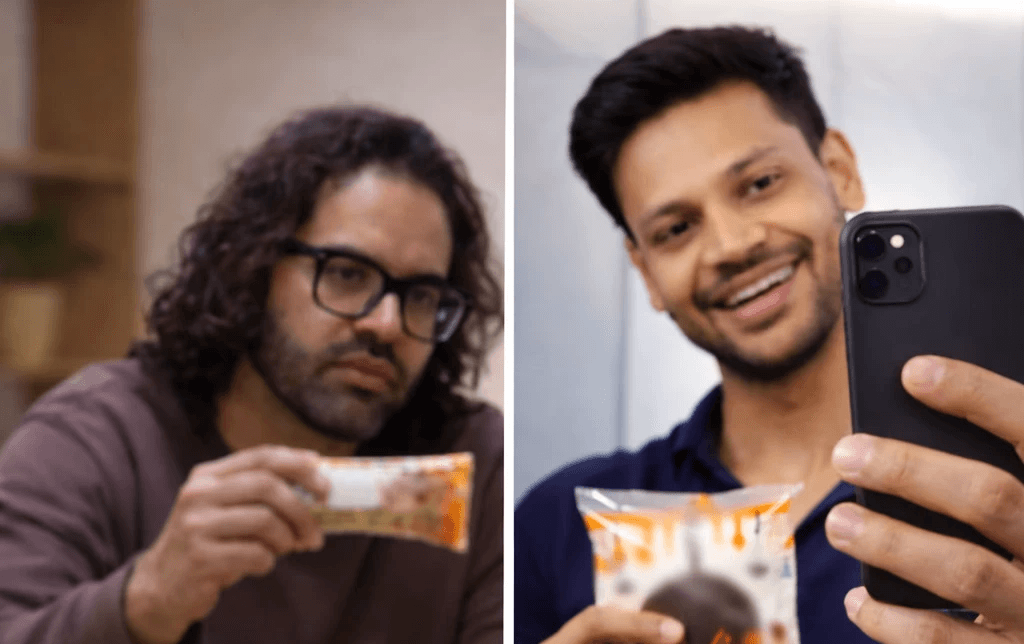
The Whole Truth Foods. 350K followers. Professional setup. Studio lighting. Graphics that probably cost more than my rent.
They were breaking down why David's low-calorie protein bar wasn't actually healthy—something about untested ingredients, long-term effects, the works.
The information was solid. The production was flawless.
And I scrolled past in 4 seconds.
Not because I didn't care.
But because it looked like... work.
Like something a marketing team approved in a conference room after three rounds of edits and a legal review.
It looked professional.
Which is exactly why it failed.
Here's what nobody tells you about social media in 2025:
Looking professional is the fastest way to become invisible.
The Whole Truth's video? It had everything:
Studio lighting
Motion graphics
Perfectly scripted voiceover
B-roll of the product
Text overlays with citations
And it died.
Meanwhile, there's a guy named Trustified on YouTube.
iPhone camera. Bedroom background. Talking directly to the lens like he's FaceTiming a friend.
No graphics. No transitions. Just him, holding a product, telling you why it's bullshit.
Millions of views.
Same message. Opposite execution.
One felt like an ad. The other felt like a conversation.
Guess which one the algorithm rewarded?
Let me show you what's actually happening.
Instagram posts with user-generated content get 70% more engagement than polished branded posts.
Read that again.
Not 7%. Seventy percent.
UGC (user-generated content) outperforms traditional branded content so dramatically that 93% of marketers now say it's more effective than anything their in-house teams produce.
And here's the kicker:
The average cost of a UGC video? $150-$300.
The average cost of a professional brand video? $5,000-$50,000.
You're spending 100x more to get 70% less engagement.
The math isn't mathing.
But it gets worse.
Instagram's algorithm changed in 2025.
Not subtly. Fundamentally.
The platform now prioritizes "shares per reach" over likes and comments.
Translation: If people are DMing your content to friends, Instagram pushes it to millions.
If they're just double-tapping and scrolling, you're dead in the water.
And here's what Instagram discovered:
People share raw, relatable content. They don't share ads.
Your $50K video with the perfect lighting and motion graphics?
It signals "brand."
And the moment our brains detect "brand," we activate our "ignore advertising" filter.
We've been trained for decades to tune out anything that looks like it's trying to sell us something.
So when your content looks too polished, too professional, too produced...
We scroll.
Not consciously. Instinctively.
Meanwhile, Instagram made another change that killed the old playbook:
Follower count no longer guarantees reach.
In May 2025, Instagram restructured its entire algorithm to prioritize "content quality and engagement velocity" over audience size.
A creator with 1,000 followers can now reach more people than an account with 100,000 followers—if their content generates superior engagement in the first hour.
This is the democratization of reach.
And it's why VC-backed brands with massive budgets are getting destroyed by solo creators filming on their phones.
Let me tell you what this actually looks like.
I spent an hour watching The Whole Truth's content.
Every video: professionally shot, well-researched, informative.
Average views: 5K-15K. (They have 350K followers. Do the math.)
Then I watched Trustified.
Messy background. Inconsistent lighting. He literally holds products up to the camera like he's showing you something he just bought.
Average views: 200K-2M.
What's the difference?
Trustified talks to you like a person.
The Whole Truth talks to you like a brand.
And in 2025, the algorithm—and more importantly, the audience—has made it very clear which one they prefer.
Here's the data that should terrify every VC-backed brand:
TikTok UGC content is 22% more effective than brand-created videos.
It outperforms Facebook ads by 32% and regular ads by 46%.
UGC-based ads on social media get 4x higher click-through rates than traditional ads.
But here's what's really happening beneath those numbers:
Brands are optimizing for what looks credible to investors.
Creators are optimizing for what actually works on the platform.
When you're burning through a VC-backed budget, you hire agencies. Agencies need to justify their fees with "professional" work. So they create studio content with high production value.
It looks impressive in a board meeting.
It dies on Instagram.
Because the person scrolling at 11 PM doesn't care about your production budget.
They care about whether your content feels like it was made for them—or at them.
There's a phrase I keep coming back to:
"Owning the streets."
It's the difference between understanding platform culture and trying to import corporate marketing into it.
Brands that own the streets:
Speak the native language of the platform
Move fast and test constantly
Sound like humans, not marketing departments
Embrace imperfection because it signals authenticity
Brands that don't:Spend weeks getting approvals
Optimize for "brand safety" over engagement
Use the same polished format across every platform
Measure success by impressions, not shares
Guess which one the algorithm rewards?
And here's the uncomfortable truth:
Your professionalism is your weakness.
When you spend $50K on a video, you can't afford to take risks.
You need legal to approve it. Brand to approve it. The CMO to approve it.
By the time it's published, it's been sanitized of anything interesting.
Meanwhile, the solo creator with an iPhone can test 10 different hooks in the time it took you to get one video through compliance.
They win because they have nothing to lose.
You lose because you're paralyzed by committee.
Let me give you the numbers on what this costs.
Professional video production: $5,000-$50,000 per video.
Includes: studio time, crew, lighting, editing, revisions, motion graphics.
Timeline: 2-4 weeks from brief to final.
Result: Looks amazing. Performs poorly.
UGC creator: $150-$300 per video.
Includes: iPhone footage, authentic testimonial, platform-native editing.
Timeline: 2-3 days from brief to delivery.
Result: Looks raw. Performs incredibly.
Oh, and here's the best part:
Brands using UGC see 29% higher web conversions and 74% better product page performance.
So you're not just saving 95% on production costs.
You're actually getting better results.
But the most damning stat of all:
YouTube UGC videos get 10x more views than brand-created videos.
Not 10% more.
Ten times more.
Same product. Same message. Different execution.
The only variable is whether it looks like an ad or a recommendation.
And people have made it very clear:
They'll watch the recommendation.
They'll skip the ad.
Here's what I think is really happening.
Social media platforms are in an existential war with traditional advertising.
For decades, ads interrupted content.
Now, content IS the ads.
And the platforms have figured out that if ads look like ads, people leave.
So they've rigged the algorithm to punish anything that signals "brand" and reward anything that signals "person."
Instagram's 2025 update actively penalizes:
Overly polished content
Engagement bait
Reposted content
Content with watermarks from other platforms
Generic motivational content
Instagram's 2025 update actively rewards:Original, raw content
High watch time (especially past the first 3 seconds)
Content that gets shared via DM
Platform-native formats
You know what all those "rewarded" behaviors have in common?
They're what individual creators do naturally.
And what brands struggle to do at all.
So here's the choice you're facing right now:
Option A: Keep doing what you're doing.
Hire the agency. Build the studio. Spend $50K per video.
Get 47 views from your existing followers who already know you.
Watch competitors with iPhones eat your lunch.
Option B: Accept that the game changed.
Hire creators who understand platform culture.
Give them a brief, a product, and freedom.
Let them make "imperfect" content that actually performs.
Track shares, not impressions.
Because here's the reality:
The internet has democratized distribution.
Follower count doesn't matter anymore.
Production budget doesn't matter anymore.
What matters is whether your content sparks a conversation or gets skipped.
And right now, professional content gets skipped.
Raw, authentic, "imperfect" content gets shared.
I'm not saying professional content is dead.
I'm saying it's dead on social media.
Your brand video still works on your website. Your sizzle reel still impresses investors.
But on Instagram, TikTok, YouTube Shorts?
It's a liability.
Because the platforms have decided that authenticity > production value.
And the data backs them up.
So here's my challenge to you:
For the next 30 days, run a test.
Take 10% of your content budget.
Instead of one $10K video, commission ten $150 UGC videos from different creators.
Give them the same brief. Let them interpret it their way.
Post them all. Track shares, saves, and DMs—not just views.
After 30 days, compare:
Cost per engagement
Share rate
Conversion (if trackable)
I'm willing to bet the UGC destroys your professional content.
Not because your team is bad.
But because they're playing a different game than the one the platform is scoring.
The Whole Truth made a great video.
It just wasn't a great Instagram video.
Trustified makes mediocre videos by production standards.
But perfect Instagram videos.
One optimized for what looks good in a portfolio.
The other optimized for what actually gets seen.
The algorithm doesn't care about your production budget.
It cares about whether people engage.
And in 2025, people engage with people.
Not with brands trying to look like people.
So go ahead.
Keep polishing.
Keep approving.
Keep making beautiful content that nobody sees.
Or accept that the scrappy creator with an iPhone just figured out what you've been missing:
On social media, creativity beats budget.
Authenticity beats polish.
And the streets eat first.
The choice is yours.
But the algorithm already made its choice.